
Recently, the Beijing Digital Intelligence Traditional Chinese Medicine Industry Development Research Institute was officially inaugurated and commenced operations at the Zhongguancun (Chaoyang) Digital Medical Industrial Park. As Beijing's first AI + Traditional Chinese Medicine (TCM) industry innovation consortium and public service platform jointly established by 12 entities—including research institutes, universities, medical institutions, and enterprises—the institute currently showcases nearly 40 representative products, covering cutting-edge fields such as brain-computer science, embodied robotics, and large language models for TCM.
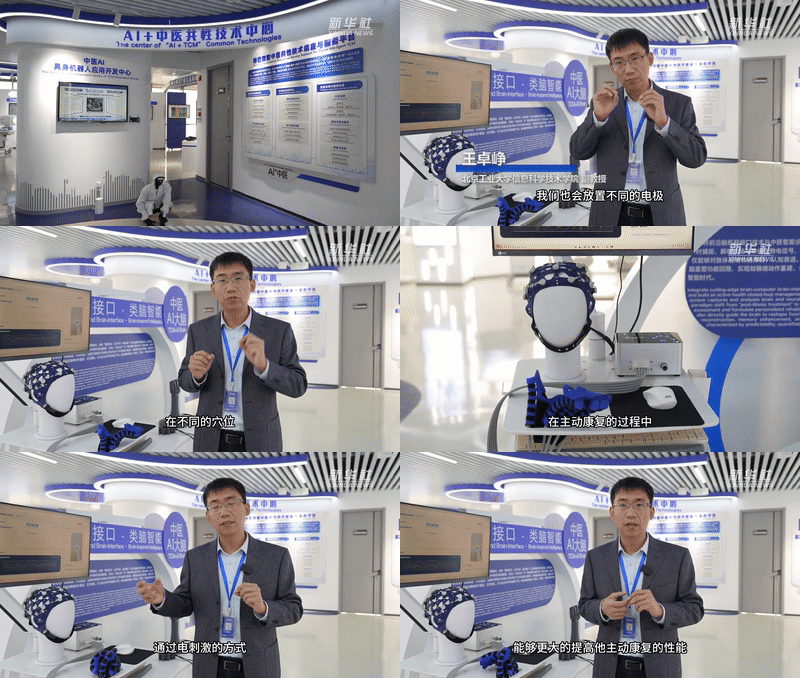
As one of the representative products in the industry, the Brain-Computer Interface (BCI) + AI non-invasive active hand rehabilitation training system, co-developed by SRT and Hangzhou Xingyuan Intelligent Biotechnology Co., Ltd., is on display at the AI + Traditional Chinese Medicine (TCM) multi-scenario demonstration center of the Beijing Digital Intelligence Traditional Chinese Medicine Industry Development Research Institute.
The product integrates SRT's technological expertise in soft robotics, including core capabilities such as flexible material molding, intelligent human-computer interaction, sensing control, and simulation design. The Brain-Computer Interface (BCI) + AI non‑invasive active hand rehabilitation training system can assist the metacarpophalangeal joints and fingertip joints in performing bionic movements such as grasping and pinching, thereby improving rehabilitation efficiency for patients with hand motor disorders. The system is suitable for scenarios including post‑stroke hand function rehabilitation.
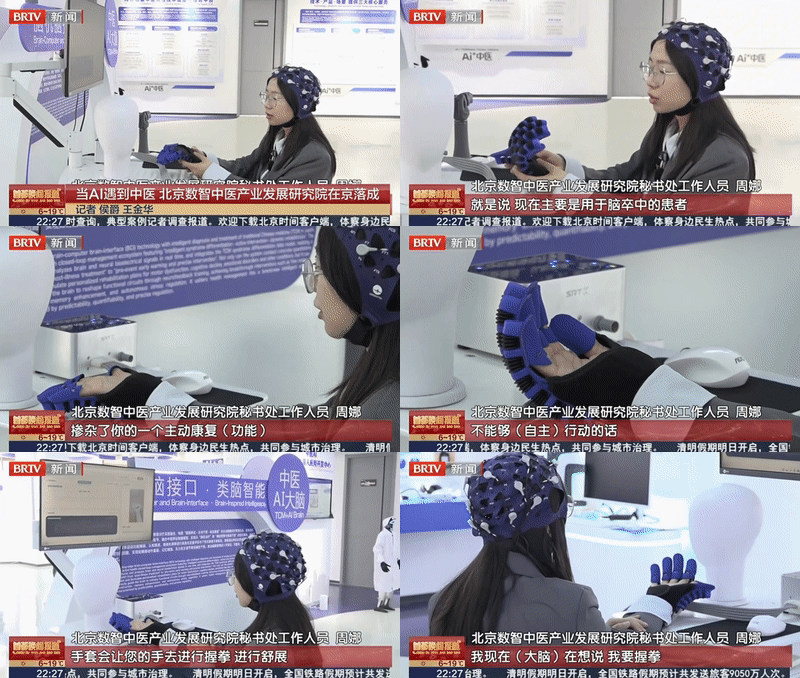
Additionally, the EEG acquisition system, based on scalp EEG signals and multimodal physiological indicator analysis, establishes a closed loop of "cortical drive → neurofeedback → muscle synergy." This introduces an active intention recognition mechanism into the rehabilitation process, advancing hand function rehabilitation from passive training toward neural-engaged intervention.
Soft rehabilitation robotics represents an interdisciplinary convergence of materials science, robotics, rehabilitation medicine, and computer science, and is evolving toward lighter weight, greater adaptability, and higher intelligence. In the future, with the continued integration of technologies such as brain-computer interfaces, advanced sensing, and virtual reality, hand rehabilitation devices are expected to achieve further improvements in clinical practicality and patient experience. SRT will continue to leverage its soft robotics technology platform and industrialization expertise to advance productization exploration and industry collaboration in areas such as rehabilitation assistance and medical health.